

In hundreds of remote villages and underserved urban districts across Pakistan, thousands of faithful believers lack a safe, dignifying place to gather for daily prayers. When local communities gather under open skies, inside fragile mud shelters, or in dilapidated structures, worship becomes vulnerable to scorching summer heat, heavy monsoon rains, and freezing winter winds. Beyond the physical discomfort, the absence of a central place of worship deprives young children of safe spaces to learn the Holy Quran and access basic moral education. Without dedicated spiritual hubs, vulnerable neighborhoods struggle to maintain social unity and pass sacred values down to the next generation. Making a masjid donation in pakistan addresses this spiritual and social gap by establishing permanent anchors of hope, worship, and community support.
When you choose to fund mosque construction through Help in Need, your contribution creates an impact far beyond bricks and mortar. A well-built masjid serves as a vibrant community center where countless prayers are offered, verses are memorized, clean drinking water is distributed, and local relief efforts are organized. Together, we can transform your generous gift into a continuous source of blessings that transforms lives across generations.
The Spiritual and Social Essence of Building a Masjid in Islam
At its foundation, supporting a mosque project is one of the most beloved acts of worship in Islamic tradition, carrying immense rewards in this life and the hereafter. The Prophet Muhammad (peace be upon him) taught that whoever builds a mosque for the sake of Allah, Allah will build for them a house in Paradise. Viewing a mosque purely as a physical building misses its deeper identity as the spiritual heart of a Muslim community. Establishing a house of Allah provides a dignified sanctuary where believers align their hearts, seek peace, and strengthen their personal relationship with their Creator.
Beyond individual worship, a masjid functions as the primary social engine for rural and marginalized populations across Pakistan. It acts as an equalizer where individuals from all socioeconomic backgrounds stand shoulder-to-shoulder in complete equality before God. A central mosque fosters deep brotherhood, resolves neighborhood disputes peacefully, and provides a safe space for collective decision-making. By uniting community members under one roof, a mosque restores dignity, preserves cultural heritage, and builds strong social resilience against poverty and hardship.
A Source of Endless Blessings (Sadaqah Jariyah)
Every prostration made, every chapter of the Quran recited, and every supplication offered inside a mosque generates continuous spiritual rewards for those who helped build it. This continuous charity yields ongoing blessings that endure long after a donor’s lifetime.
Restoring Dignity to Rural Communities
Villages without a proper mosque often struggle with feelings of isolation and neglect. Constructing a clean, durable, and spacious house of worship brings immense joy, pride, and spiritual security to local families.
Unifying Diverse Neighborhoods
A central mosque serves as an open hub where community members gather for daily prayers, Friday sermons, and seasonal Eid celebrations. Regular congregation breaks down social barriers and builds lasting trust across generations.
The Multi-Functional Role of Mosques in Underserved Areas of Pakistan
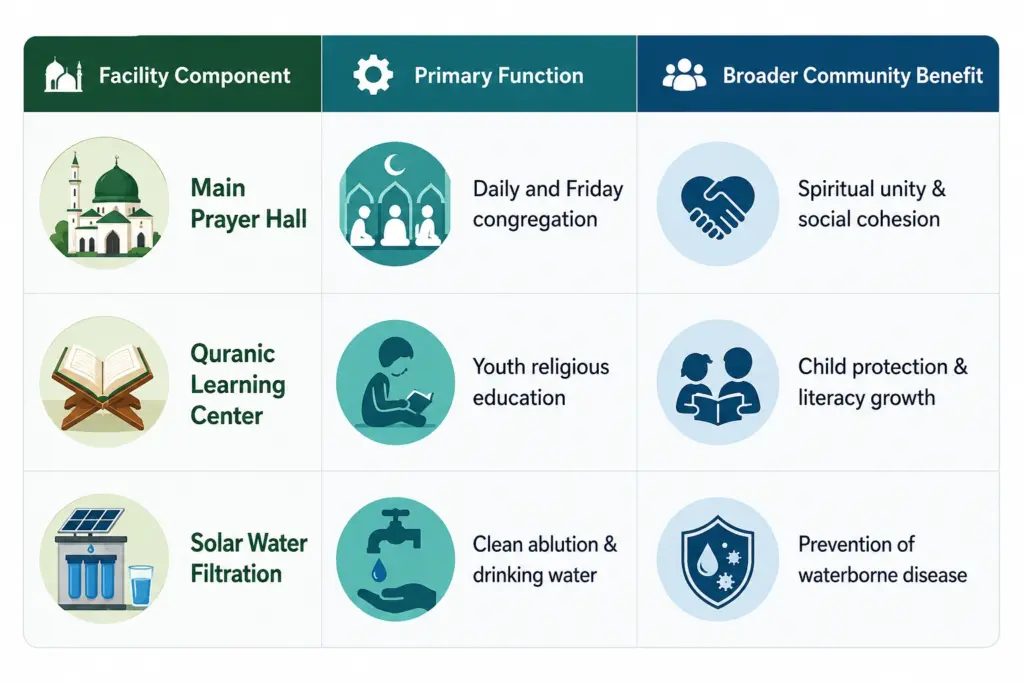
To fully appreciate the value of your contribution, one must understand that a village mosque in Pakistan is rarely just a prayer hall. In resource-scarce environments, a newly constructed mosque serves as an all-in-one community complex that meets both spiritual and physical needs. Integrating clean water filtration systems, solar power units, and classrooms into mosque design multiplies the project’s overall social benefit.
Connecting physical health initiatives with spiritual spaces guarantees that the entire village benefits daily from the facility. Children gain safe learning environments during the day, while families collect clean drinking water after congregational prayers.Transforming Villages Across Pakistan Through Strategic Mosque Construction
Directing charity toward structured construction initiatives brings sweeping positive changes to vulnerable regions in Khyber Pakhtunkhwa, Punjab, Sindh, and Balochistan. In disaster-prone or economically depressed zones, local residents lack the financial means to construct durable brick-and-mortar facilities on their own. Strategic funding from generous donors bridges this gap, giving disadvantaged communities access to safe, long-lasting infrastructure.
When Help in Need manages a construction campaign, local workers and builders are hired directly, stimulating local micro-economies. Furthermore, community leaders are involved in planning and maintenance, ensuring long-term local ownership and sustainability. The benefits of supporting planned mosque development include:
- Safe All-Weather Shelter: Solid roofing and reinforced walls protect worshippers from extreme heat waves, flash floods, and winter rains.
- Protection for Young Students: Dedicated classrooms shield children from studying in harsh outdoor conditions or unsafe temporary structures.
- Integrated Solar Power: Solar panel systems guarantee continuous lighting and cooling during frequent grid power outages.
- Empowerment of Local Labor: Construction projects create temporary employment for local masons, carpenters, and laborers.
Ensuring Financial Integrity, Transparency, and Field Accountability
For a major charity project to fulfill its spiritual and practical goals, executing organizations must maintain strict standards of financial governance. Donors need complete confidence that their hard-earned contributions are utilized efficiently to construct high-quality, long-lasting facilities. Modern non-profit organizations utilize rigorous project auditing, architectural oversight, and regular progress updates to maintain complete transparency.
Help in Need operates with full official accreditation, holding certifications from the Pakistan Centre for Philanthropy (PCP) and tax-exempt status from the Federal Board of Revenue (FBR). These formal credentials verify that every project adheres to strict standards of financial management, legal compliance, and operational excellence.
Comprehensive Site and Need Assessments
Field teams conduct detailed surveys to identify communities that genuinely lack adequate prayer facilities. Priority is given to remote, flood-affected, or high-poverty villages with no existing brick-and-mortar mosques.
Rigorous Engineering and Financial Audits
Licensed structural engineers oversee every phase of construction, from foundation laying to final finishing. Independent financial audits confirm that all material costs and labor expenses remain transparent and on budget.
Open Communication and Progress Reporting
Donors receive regular milestone updates, including photos, GPS coordinates, and completion reports. Clear communication allows supporters to witness the exact real-world impact of their generosity.
Practical Steps to Plan Your Mosque Donation Today
Planning a mosque donation requires choosing the giving model that best aligns with your budget and spiritual goals. Whether you wish to fund an entire village mosque independently or pool funds with family members, every contribution brings vital facilities closer to completion.
By taking an organized approach to your giving, you ensure that your contribution creates immediate, sustainable benefits for a deserving community.
To put your intentions into immediate practice, consider these two actionable steps today:
Combine resources with relatives, friends, or coworkers to collectively sponsor a complete village mosque, making a major infrastructure project accessible and affordable.
Fund a mosque or an integrated solar water well in memory of a deceased parent or loved one, establishing a continuous source of blessings (Sadaqah Jariyah) in their honor.
Sponsoring Construction Shares
If funding an entire mosque independently is out of reach, purchasing construction shares allows you to join forces with other donors. Shared contributions pool together to build high-quality facilities that no single donor could complete alone.
Adding Educational Facilities
Allocating extra support toward classroom furniture, Quran copies, and sound systems turns a simple prayer hall into a thriving educational center. Enhanced amenities improve the learning experience for young village students.
Long-Term Maintenance Funds
Setting aside a small maintenance allocation guarantees that minor repairs, plumbing fixes, and repainting are handled smoothly over time. Regular upkeep keeps the house of Allah clean, safe, and welcoming for years to come.
FAQs
How much does it cost to make a masjid donation in Pakistan?
Costs vary based on size, location, and added facilities (like solar water pumps), ranging from partial construction shares to complete village mosque sponsorships.
Is building a mosque considered Sadaqah Jariyah?
Yes, constructing a mosque is a premier form of Sadaqah Jariyah because it provides ongoing spiritual and physical benefits for generations.
Can I dedicate a mosque project in memory of a loved one?
Absoluely. You can dedicate the entire mosque or an integrated water facility in honor of a family member, with a commemorative plaque installed at the site.